

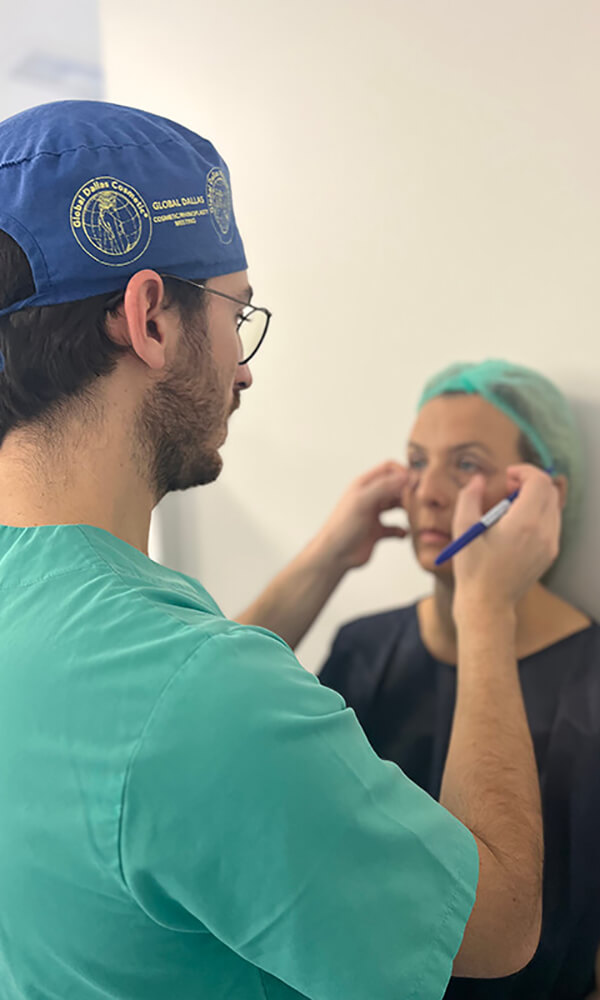
What is it?
Blepharoplasty is the surgery that rejuvenates and enhances the openness and expression of the eyes. It can be categorized as upper or lower blepharoplasty, targeting the upper and lower eyelids, respectively.
When is it indicated?
The primary reason for undergoing this surgery is periorbital aging, which is characterized by skin laxity and excess skin on the eyelids. It's common from the fourth or fifth decade of life, often resulting in a closed, less expressive and more tired appearance. In severe cases, there may be a functional compromise with vision impairment. Excess fat in the eyelids, especially in the lower eyelids, or ptosis of the upper eyelids are also frequent motivations for these procedures.
How is the procedure performed?
Upper blepharoplasty involves the removal of excess skin from the upper eyelids, excision of excess fat from their fat pads, and the correction of the upper eyelid levator muscle in cases where there's ptosis. Conversely, lower blepharoplasty allows for the removal of excess skin from the lower eyelids, excision of excess fat from their fat pads, and correction of lower eyelid laxity through lateral canthopexy or canthoplasty, meaning through plication or repositioning of the lateral cantus.
What type of anesthesia is used?
Isolated upper blepharoplasty can be performed under local anesthesia, while lower blepharoplasty alone or in combination with upper blepharoplasty should be performed under general anesthesia.
Can it be combined with other surgeries?
It's often combined with other facial surgeries, namely brow lift, facelift, and neck lift. Combining these surgeries can enhance overall facial rejuvenation.